Showing posts with label Research. Show all posts

Monday, 5 May 2014

Malala Yousafzai

 Malala Yousafzai is a 16 year old Pakistani school pupil and education activist from the town Mingora in the Swat District of Pakistan's north western Khyber Pakhtunkhwa province. She is known for her activism for rights to eductaion and for women, especially for where she lived, as the Taliban had at times banned girls from attending school school. At the age of 11, Yousafzai wrote a blog under a pseudonym for the BBC talking about her life under Taliban rule, their attempts to take control of the valley, and her views on promoting education for 22 girls. The New York Times created a documentary, filming her life as the Pakistani military intervened in the region, starting the Second Battle of Swat. Yousafzai willingly gave interviews in print and television, and she was nominated for the International Children's Peace Prize by South African activist Desmond Tutu.

9th October 2012, Yousafzai boarded her school bus in her home town, where a gunman asked which one was Yousafzai and then shot her three times. For days she was in critical conditions and was unconscious, but it soon improved allowing her to be transferred to Queen Elizabeth Hospital in Birmingham for intensive rehabilitation.  On 12 October, a group of 50 Islamic clerics in Pakistan issued a fatwa against those who tried to kill her, but the Taliban reiterated its intent to kill Yousafzai and her father.

The assassination attempt caused national and international support for Yousafzai. United Nations Special Envoy for Global Education launched a UN petition in Yousafzai's name, using the slogan "I am Malala" and demanding that every child worldwide would be in school by the end of 2015. Yousafzai was featured in Time Magazine, under as one of 'The 100 Most Influential People in the World'. She was also the winner of the first ever Pakistan's national Youth Peace Prize and was the youngest nominee for 2013 Noble Peace Prize.

From reading about Malala Yousafzai, I have learnt about the giant impact she has made on society and how she has helped in getting not only women in education, but all children around the world.

Tuesday, 25 March 2014

John Galliano Scarves

Floral and Newsprint Silk Scarf
 On the TK Maxx website, I've come across scarves designed by John Galliano that include a design method I'm fond of: layering text and images. My reaction to this style is how I could apply it to my focus of feminism. I could use old and new articles talking about the development of feminism with a layer of iconic images over the top. I could also include prints and designs of some of my samples, including scans of my knitting (creating a texture). This method could obscure and portray all my thoughts and research onto one piece, also representing the achievements women have made towards equality. I also want to show the stereotypes of women and what they are expected of, and also what is the 'ideal' women?


Female scarves tend to have a feminine style to it (typically flowers). I could keep to the feminine theme, so at first glance you would see something like a floral print but up close is something unexpected (like the newsprint that is disguised by the flowers).

I could use an already made scarf and decorate it like Orly Cogan, and add objects similar to Caren Garfen's designs. Or I could knit a scarf and embroidery designs.
Newspaper Print Silk Scarf


The shape of the scarf when it is put on a body obscures the design making it unclear. The design would make people search through the scarf to try and understand it.

This scarf includes a floral design like the other one, but includes elements of lace on top of the newsprint.

Monday, 24 March 2014

Preti Veja and Weaving

Veja is a textile artist who focuses on working with weaving and structure.


She uses structure to shape her weaves into different shapes and forms to represent something. 
I found this method inspiring, as I wanted to recreate the flower, curved shape of Marilyn Monroe's white dress from 'The Seven Year Itch'. For creating structure and shape like her work, I used wire as a base and then wool for the texture.

Weaving is a very traditional method that has been round for centuries to create fabric. Usually it would be the woman's job to create fabric by using a loom. Looms have developed over the years, and have now become powered machines (like the knitting machines).

Wednesday, 19 March 2014

The History of Knitting

From studying feminism, I was thinking about what type of traditional female textiles there is. Knitting  is a very feminine skill, which has been around since the 11th century. In most cultures, it was the woman's job to knit garments and blankets.

During the Industrial Revolution however, knitting devices were created and put in factories, where they would then hire women to work the machinery than to knit items at home. The city of Nottingham was known for creating machine-made lace in the revolution and the following decades. Leicestershire was known for having portable machines that can be hired for people the machine knit at home.

The mid nineteenth century saw the beginnings of knitting as a hobby. They began to make printed patterns aimed mostly at middle class women. Yarns started being produced specifically for the domestic market. So instead of knitting being part of an industry or commercial necessity, it became pleasurable and a useful pastime.

In the 1920s, knitwear became highly fashionable in the western world. Particularly sweaters/pullovers became a great part in the new fashions of the age for men, women and children, instead of the more practical garments associated with workers such as fishermen. Knitted neckties also became fashionable in the late teens and early 1920s. Soon later, knitwear was associated with sport and leisure such as tennis and cricket.

High fashion such as Coco Chanel and Vogue magazine were also interested in the knitwear craze.

The growth of interest in home/hobby knitting grew during the First World War. The Allied home front was encouraged to support the troops by knitting, as the conditions of trench warfare lead to a shortage of socks. Because home knitting soon became popular, especially for fashion, there was a high demand for companies to produce patterns, yarn and tools.

During World War II, the British wartime government department produced a booklet called 'Make Do and Mend' (published in 1943). This is because wool became very short in supply, and the booklet encouraged women to unpick old unwearable woollen items so they could reuse the wool. This is a big difference to the first war when it was extremely fashionable and affordable to make and own knitted garments, and then in the second war having to use old wool.

Knitting patterns were given out so that people could make clothing for the Army to wear in the winter, such as balaclavas and gloves. This effort gave a positive sense of contribution to the home front. This tells us that women played an important role in the war knitting, alongside their other jobs of working in the factories and farming.

1950s and 1960s, knitting again had a huge boost. This is because newer colours and yarns were introduced, with thousands of patterns for fashionable designs in bright colours. An knitted garment combo called the twinset became very popular for the home knitter: It was a short-sleeved top with a long-sleeved cardigan in the same colour to be worn together.

Girls were taught to knit in school as a useful hobby. This suggests some stereotypes of girls being better at textiles, and also suggesting the idea of knitting being a feminine skill.

1980s, knitting became unpopular as it was seen as old fashion and soon died out.

21st century, there has now been a revival of knitting. The growth of knitting started to grow alongside the growth of the internet and internet-based technologies, as well as the "Handmade Revolution".

Amanda Seyfried
Yarns have been developed better, as we are now using natural fibres from animals such as alpacas and exotic fibres such as silk. Designers have now begun to make patterns that work up quickly on large needles, known as instant-gratification knitting.

There has also been many female celebrities seen knitting which is believed to of helped popularise the skill. Some men have also been knitting, suggesting that the feminine stereotypes have died down a little.

Thanks to the internet growing, it allows knitters to connect, share interests and learn from each other from all over the world.

Patterns from both books and online sources have influenced groups that are centred on knitting a specific pattern. Because of knitting blogs, traditional designs and techniques that have been kept secret by a small number of hand knitters now have a much larger audience.

Yarn Bombing, a type of contemporary graffiti art has spread worldwide, decorating statues and fences.

14th January, 2006, knit-blogger Stephanie Pearl-McPhee challenged knitters worldwide to participate in the 2006 Knitting Olympics. Their task was to do a challenging project starting at the opening ceremonies of the 2006 Wither Olympics, and have the project done by the time the Olympic flame was extinguished 16 days later. Around 4,00 people took part in this event.

From researching on the history of knitting and how it has developed so  much in the 20th and 21st century, I am able to see how knitting became popular during the war for the women at home to how knitting was died out as it was seen as an old fashioned skill, to becoming a worldwide community with both genders taking part. From my experience however, I still believe that knitting is seen as a feminine skill (as well as other textile craft) even though there are men who knit.

Freddie Robins, who I have previously looked at, uses knitting in an unusual way by creating misshapen garments and sculptures to represent an issue or idea. Robins is very passionate when it comes to feminism, and it tends to reflect in many pieces of her work.
Robins and Alice Angus (textile artist) were asked to create a response to 1950s photographs by John French (1907-1966). Robins response to this was creating a woollen ghost figure hidden in a cupboard, as she wanted to reflect how women were still rationing materials:


'He's Behind You',
2011,
machine knitted yarn,
metal coat hanger, found wardrobe
“The stereotypical image of the fifties is of a modern, clean world where glamorous women flit around homes filled with contemporary, colourful design by the likes of Lucienne Day. The truth for most women was quite different. The shadow of the war still loomed, rationing for textiles and clothing hadn’t ended until 1949”


Friday, 14 March 2014

We Can Do It


"We Can Do It!" is an American wartime propaganda poster created in 1943 by J. Howard Miller. It was made for Westinghouse Electric to be inspirational and boost the worker morale. It is believed that the poster was based on a black and white wire service photograph of a factory worker Geraldine Hoff.

Geraldine Hoff
 The poster was seen very little during World War II, but was rediscovered in the 1980s. It was then recreated in many forms, usually still called "We Can Do It" but was also called "Rosie the Riveter" after the iconic figure of a strong female war worker. The poster was used in the 80s to promote feminism and other political issues. In 1999, the poster design was turned into a US first-class stamp. In 2010, the poster was redesigned to celebrate the first woman becoming the prime minister of Australia. Pink, an American singer, included herself dressed up as "Rosie the Riveter" in her music video for "Raise Your Glass", which is a song about the "celebration for people who feel left out from the popular crowd" - Suggesting to being strong.


It’s A Tradition With Us, Mister!
J. Howard Miller

Norman Rockwell's Saturday Evening Post 
cover featuring Rosie the Riveter
Pink - Raise Your Glass

Veronica Lake
The poster uses primary colours making it extremely eye catching and bright - could help lighten the workers mood. The figure in the design has feminine features but comes across rather butch, suggesting masculinity and strength. But the feminine features includes a full face of make up that is glamorously done - heavily darkened eyes, blushed cheeks, neatly plucked arched eyebrows, and pouted lips. Women from the 1940s idolised the glamorous celebrities such as Gene Tierney and Veronica Lake.
Gene Tierney


Norma Jean Baker AKA
Marilyn Monroe
Marilyn Monroe was discovered by a photographer whilst working in a factory during the war, where she mainly sprayed aeroplane parts with fire retardant and inspected parachutes.

Monday, 20 January 2014

More Research on the Hensel Twins

 Youtube videos of the twins: First one of when they were children and the second one of them as adults on holiday. In both videos, you see them as confident and happy, and not afraid of being themselves.

In the first video they answer questions people have asked them, for instance: "Do you fight? All the time" and "Do you have two heads? No". Them answering "No" to the two heads question, shows how they believe being known seperately is important to them


In the second one we learn about what they are planning on doing as a career: Primary math teachers. We also see how they both use amazing teamwork to work together in everyday routines, like doing each others hair and make up, and also preparing a meal.


Here are some questions and medical quotes about the Hensel twins.


Saturday, 11 January 2014

Abby and Brittany Hensel

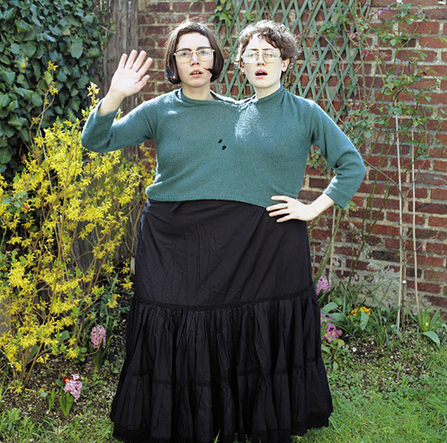
Looking at conjoined twins, I've decided to look at a set of very famous twins: Abby and Brittany Hensel. They were born with two heads (two separate, individual minds), two spines, two arms (although was born with three), one ribcage, four lungs (so a set each) with two merging in the centre, two hearts but a shared blood system, two stomachs, one liver (larger then the typical liver), one small and large intestines, one bladder, one set of reproductive organs, and two legs.


To understand what the twins are like, I've watched one of their documentaries 'Joined for Life'. In this documentary the twins have just turned sixteen. It focuses on their school life and how they are coping with it. The audience learns more about their situation and how brilliant their teamwork is as the twins take on typical teen life, like learning to drive and spending time with their friends.

Thursday, 9 January 2014

Freddie Robins

Lucy and Jorge Orta


Conjoined Twins

After looking at identical and un-identical twins, I've decided to have a look at some conjoined twins. This is because they are a lot closer to each other and and have pretty much the same memories, suggesting they might have similar personalties. They also share a body so their garments would be unique, as they are adjusted to fit them.


Their clothes are usually created by joining two garments together, adjusted in the areas the conjoined twins are joint to make it fit perfectly for the body. Some garments end up being more complicated than others, depending on the shape of the twins.